
BASIC FIRST AID & CPR
Course 2: CPR, Recovery Position & Choking Emergencies
Estimated Reading Time: 25–30 minutes
Difficulty: Beginner
Mandatory for All Aron Helps Workers
Important: This course is for educational purposes and does not replace practical CPR training from a recognised first aid instructor. Always follow the guidance of your local emergency medical services where applicable.
Introduction
A person whose heart has stopped or whose airway is blocked has only a few minutes before permanent brain damage can occur. Knowing how to recognise these emergencies and respond correctly can save a life.
In this course, you will learn the basics of:
- Adult CPR
- Child CPR
- Infant CPR
- Hands-only CPR
- The recovery position
- Choking first aid
- Automated External Defibrillators (AEDs)
Learning Objectives
By the end of this course, you should be able to:
- Recognise cardiac arrest.
- Begin CPR safely.
- Place an unconscious breathing person in the recovery position.
- Help a choking adult, child, or infant.
- Understand the purpose of an AED.
- Know when to stop CPR.
Lesson 1: What is Cardiac Arrest?
Cardiac arrest happens when the heart suddenly stops pumping blood effectively.
Without treatment:
- The brain is deprived of oxygen.
- Breathing stops or becomes abnormal.
- Death can occur within minutes.
Signs include:
- Person is unresponsive.
- Not breathing normally or only gasping.
- No signs of normal movement.
Cardiac arrest is different from a heart attack.
A heart attack is caused by blocked blood flow to the heart. A person having a heart attack is often awake and breathing, although they need urgent medical attention. Cardiac arrest usually requires immediate CPR.
Lesson 2: When Should You Start CPR?
Start CPR if:
✔ The area is safe.
✔ The person is unresponsive.
✔ They are not breathing normally.
Call emergency medical services immediately or ask someone else to call while you begin CPR.
If an AED is available, ask someone to bring it.
Lesson 3: Adult CPR (Basic Awareness)
If an adult is not breathing normally:
- Ensure the area is safe.
- Check for a response.
- Call emergency services.
- Place the person flat on their back on a firm surface.
- Kneel beside their chest.
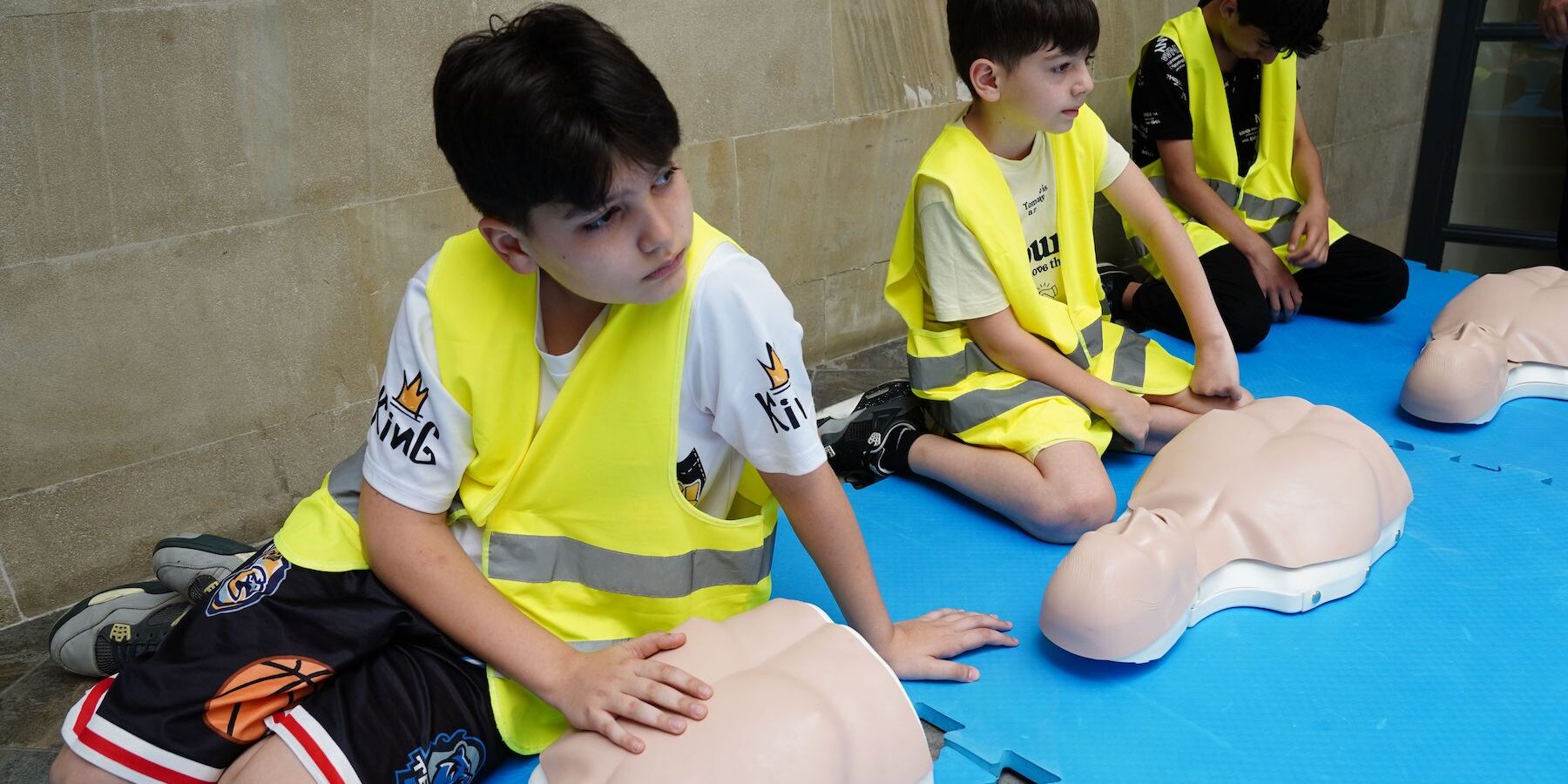
Chest Compressions
- Place the heel of one hand in the centre of the chest.
- Place your other hand on top.
- Keep your arms straight.
- Push hard and fast.
- Allow the chest to fully rise between compressions.
Continue compressions until:
- Professional help arrives.
- An AED is ready to use.
- The person starts breathing normally.
- You are physically unable to continue.
If you have received formal CPR training and are confident to do so, follow your training regarding rescue breaths. If you are not trained or unwilling to provide rescue breaths, perform hands-only CPR by giving continuous chest compressions.
Lesson 4: Child CPR
Children are not simply “small adults.”
For children:
- Follow the same basic emergency assessment.
- Begin CPR if the child is unresponsive and not breathing normally.
- Use only the amount of force needed to compress the chest appropriately for the child’s size.
- If trained, follow recognised child CPR guidance, including rescue breaths.
Always call emergency services as soon as possible.
Lesson 5: Infant CPR
Infants (under one year old) require special techniques.
If an infant:
- Is unresponsive.
- Is not breathing normally.
Call for emergency help immediately.
Only perform infant CPR if you have received appropriate training.
Infant CPR differs from adult CPR in hand placement, compression depth, and technique, so it is important to receive practical instruction.
Lesson 6: Hands-Only CPR
Hands-only CPR is recommended for many adult cardiac arrest situations if you are not trained to provide rescue breaths.
It involves:
- Calling emergency services.
- Beginning continuous chest compressions.
- Continuing until help arrives or the person recovers.
Doing something is often better than doing nothing.
Lesson 7: The Recovery Position
If a person is:
✔ Unconscious
✔ Breathing normally
Place them in the recovery position (unless you suspect a spinal injury).
The recovery position helps:
- Keep the airway open.
- Reduce the risk of choking on vomit or saliva.
Continue to:
- Monitor breathing.
- Stay with the person.
- Wait for emergency services.
If the person stops breathing normally, begin CPR.
Lesson 8: Helping a Choking Adult
Signs of severe choking include:
- Unable to speak.
- Unable to cough effectively.
- Difficulty breathing.
- Hands clutching the throat.
- Blue lips or face.
If the person can cough, encourage them to keep coughing.
If they cannot breathe or speak:
- Call for emergency help immediately.
- Provide appropriate first aid for choking if you have been trained.
- Continue until the object is expelled, the person begins breathing normally, or emergency services take over.
If the person becomes unconscious, begin CPR.
Lesson 9: Helping a Choking Child or Infant
Children and babies can choke on:
- Grapes
- Peanuts
- Small toys
- Coins
- Buttons
- Pieces of food
Keep small objects away from young children.
If choking occurs:
- Call for help immediately.
- Follow recognised child or infant choking first aid techniques if you have been trained.
- Never place your fingers blindly into a child’s mouth, as this can push the object further in.
Seek medical assessment after a serious choking incident, even if the object is removed.
Lesson 10: Automated External Defibrillators (AEDs)
An AED is a portable device that can analyse the heart’s rhythm and, if appropriate, deliver an electric shock to help restore a normal heartbeat.
AEDs are designed for public use.
If an AED is available:
✔ Turn it on.
✔ Follow the spoken instructions.
✔ Ensure no one is touching the person when instructed.
Never be afraid to use an AED—the device will only advise a shock if it is appropriate.
Real-Life Scenario
David is working as a driver for a family.
While loading luggage into the car, his employer suddenly collapses.
David checks that the area is safe, calls the employer’s name, and gently taps their shoulder.
There is no response and the employer is not breathing normally.
David immediately asks a neighbour to call emergency services and bring the AED from the nearby security office.
He begins hands-only CPR while waiting for emergency responders.
His quick action gives the employer the best possible chance of survival.
CPR & Choking Emergency Checklist
If someone collapses:
✅ Check for danger.
✅ Check for a response.
✅ Call emergency services.
✅ Check for normal breathing.
✅ Begin CPR if needed.
✅ Use an AED if available.
If someone is choking:
✅ Encourage coughing if they can cough.
✅ Call for help if they cannot breathe or speak.
✅ Provide appropriate choking first aid if trained.
✅ Begin CPR if they become unresponsive.
Common Mistakes Beginners Make
❌ Waiting too long before calling emergency services.
❌ Assuming gasping means normal breathing.
❌ Giving food or water to a choking person.
❌ Leaving an unconscious person alone.
❌ Being afraid to use an AED.
❌ Stopping CPR too soon without a valid reason.
Summary
Quick action saves lives. Recognising cardiac arrest, calling emergency services promptly, beginning CPR, using an AED when available, and responding correctly to choking emergencies are among the most important life-saving skills any caregiver can have.
Remember:
It is better to act quickly than to do nothing while waiting for help.
Knowledge Check
1. CPR should begin when a person is:
A. Sleeping.
B. Unresponsive and not breathing normally.
C. Complaining of a headache.
D. Sitting comfortably.
Answer: B
2. An unconscious person who is breathing normally should usually be placed in:
A. A chair.
B. The recovery position (unless a spinal injury is suspected).
C. A standing position.
D. A bathtub.
Answer: B
3. If an adult is choking but can cough effectively, you should:
A. Encourage them to keep coughing.
B. Immediately give them food.
C. Lay them flat.
D. Ignore them.
Answer: A
4. An AED:
A. Can only be used by doctors.
B. Gives clear voice instructions and only advises a shock when appropriate.
C. Is dangerous to everyone nearby.
D. Replaces CPR completely.
Answer: B
5. Hands-only CPR involves:
A. Continuous chest compressions without rescue breaths.
B. Rescue breaths only.
C. Moving the person into a chair.
D. Waiting for an ambulance.
Answer: A
Practical Assignment
You are babysitting a five-year-old child at home.
During lunch, the child suddenly begins choking and cannot speak.
Describe, in order:
- How you would recognise that the child is choking.
- When you would call for emergency medical help.
- What actions you would take while waiting for help.
- What you would do if the child became unconscious.
Congratulations!
You have completed Basic First Aid & CPR – Course 2: CPR, Recovery Position & Choking Emergencies.
In Course 3, you will learn how to respond to common injuries, including:
- Severe bleeding.
- Cuts and wounds.
- Burns and scalds.
- Nosebleeds.
- Sprains and fractures.
- Head injuries.
- Eye injuries.
- Safe bandaging techniques.
Recommended YouTube Videos
1. St John Ambulance – CPR & AED Demonstrations
https://www.youtube.com/@stjohnambulance
2. British Red Cross – CPR and Choking First Aid
https://www.youtube.com/results?search_query=British+Red+Cross+CPR+choking
3. American Red Cross – CPR Training
https://www.youtube.com/@americanredcross
4. Resuscitation Council UK – Basic Life Support
https://www.youtube.com/results?search_query=Resuscitation+Council+UK+basic+life+support
5. British Heart Foundation – Hands-Only CPR
https://www.youtube.com/results?search_query=British+Heart+Foundation+hands+only+CPR
Aron Helps Professional Tip
When someone experiences a cardiac arrest or severe choking, confidence comes from preparation. Learn the correct techniques, practise them in a recognised practical training session whenever possible, and never delay calling emergency services or help from neighbours. Early recognition, prompt CPR, and the use of an AED can dramatically improve a person’s chances of survival.