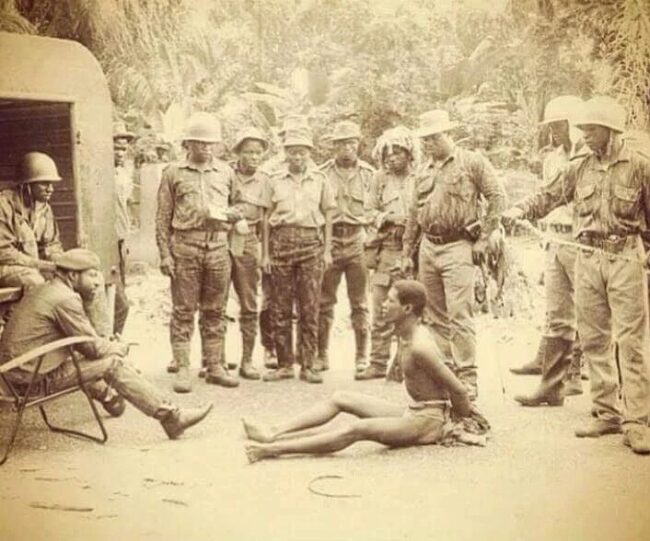
Image of a Biafran Prisoner During the Civil War
This 1968 photo shows a young Brigadier-General Alabi-Isama in Asaba talking with a Biafran POW who had been taken prisoner by Nigerian forces during the Nigerian Civil War.


This 1968 photo shows a young Brigadier-General Alabi-Isama in Asaba talking with a Biafran POW who had been taken prisoner by Nigerian forces during the Nigerian Civil War.
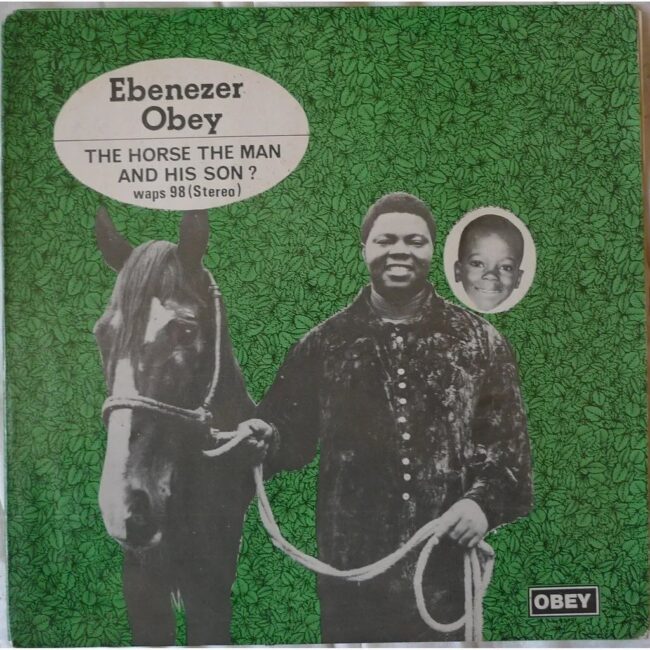
*The Horse, The Man, His Son* is one of the most well-known songs in Obey’s vast career. This narrative-driven song, which lasts 19 minutes, is a powerful lesson about human nature and the pointlessness of trying to win over everyone. Obey sings about a man, his son, and their horse in a straightforward narrative, showing how people will always find fault with anything you do. The story’s obvious lesson is that, in the end, it’s better to go along your own road and disregard the opinions of others. The current rivalry between Davido and Wizkid is well-known to many, yet it is nothing compared to the epic musical rivalry between Chief Commander Ebenezer Obey and King Sunny Ade. These two Juju music icons produced an amazing amount of timeless songs that influenced the soundscape of Nigerian music over their nearly three-decade amicable but intense rivalry. Their rivalry was distinct due to the caliber and cultural influence of their music in addition to its endurance. Both musicians’ songs evolved into timeless classics that continue to be adored today. It’s difficult to think of any contemporary artistic rivalry that will have the same enduring impact as theirs did. The song’s global concept is what keeps it relevant over time. Listeners from many eras and cultural backgrounds find resonance with the message, especially in the South-Western community where its philosophical insight is widely acknowledged. The concept’s simplicity, combined with Obey’s captivating narration and melodic arrangement, have solidified *The Horse, The Man, His Son* as one of Nigerian music’s most enduring and cherished songs. This song, which is practically a household staple in Yoruba culture, is timeless in its relevancy and serves as a reminder of the allure of plain narrative and music.
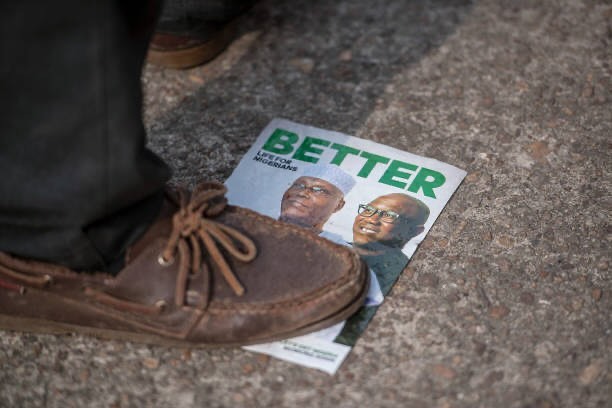
With Peter Obi, a former Anambra State governor, as his vice presidential running partner, Atiku Abubakar was the PDP’s nominee for president in 2019. Former Anambra State Governor Peter Obi served as President Olusegun Obasanjo’s deputy from March 17, 2006, to his impeach- ment on November 3, 2006. He served until 2010 after being reinstated on February 9, 2007. Up till March 7, 2014, he was reelected to a second term.
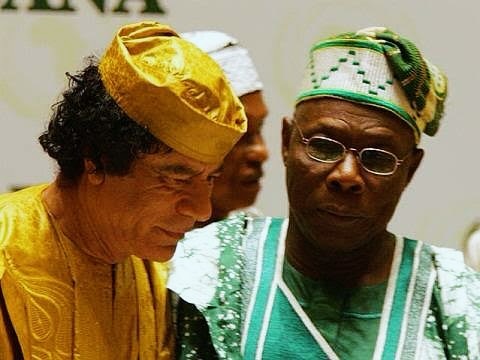
In Tripoli, President Moamer Gadaffi greets President Olusegun Obasanjo of Nigeria. The two presidents got together to talk about the Organization of African Unity’s planned extraordinary summit, which is set to take place in Tripoli in September 1999. Following is Senegalese politician Abdoulaye Wade, who served as Senegal’s third president in the early 2000s. Beginning in 1978, Wade ran for president four times before winning the office in 2000.He was defeated in 2012 in a contentious campaign for a third term, but he was re-elected in 2007 with a majority in the first round. In 1997, Muammar Gaddafi traveled to Nigeria, landing in Kano just before General Sani Abacha passed away. Gaddafi, who ruled Libya from 1969 to 2011, and Obasanjo, who led Nigeria as its military head of state from 1976 to 1979 before being elected president from 1999 to 2007, have long been respected by the military community.
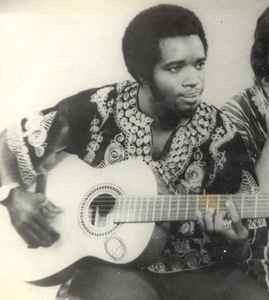
Known by most as Guitar Boy, Professor Victor Uwaifo was one of the most well-known musicians in Africa. He was born in 1941 in Benin City, Edo State, and had a great life until dying in his hometown in 2021. Uwaifo was a Nigerian musician, author, sculptor, instructor at universities, creator of musical instruments, and cultural icon. Moreover, he was appointed as the first Honorable Commissioner for Arts, Culture, and Tourism in Nigeria. With his popular song *Joromi*, Uwaifo made history in 1965 by being the first African to win a gold disc. For classic songs like *Guitar Boy*, *Arabade*, and his *Ekassa* and *Akwete* music series, he went on to win seven additional gold discs. Performing as “Victor Uwaifo and His Titibitis,” he had a lasting impression on African music and culture.
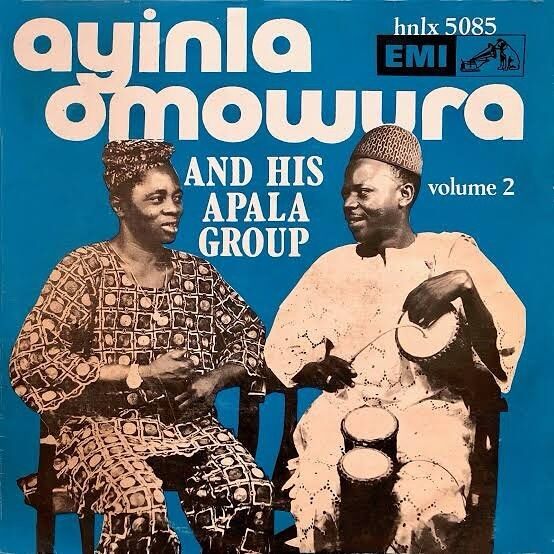
Ayinla Omowura lacked a formal education, but he was well-versed in current affairs and possessed a command of puns, proverbs, and metaphors. He was a moral guru, social critic, and pundit who frequently spoke up for the common man. He expressed the public’s concerns to the government and the administration’s policies to the general public through his songs. Fela Anikulapo Kuti recognized Omowura, one of the few musicians, for utilizing his songs to oppose corruption and the government. While applauding the government for raising pay, Omowura advocated the same for the private sector in his 1976 album *Owo Udoji. He clarified the Lagos rent legislation in *Orin Owo Ile Eko* and commended Mobolaji Johnson’s Lagos State government for its people-friendly initiatives. Along with discussing the 1973 National Census, he also covered the 1973 Challenge Cup ’73 and the transition from driving on the left to driving on the right, as well as the British Pound to the Naira and Kobo under General Yakubu Gowon. In addition to reflecting current events, his music championed social change by applauding athletics and denouncing things like promiscuity and skin bleaching. Omowura was dubbed “Hadji Costly” for his ostentatious fashion sense, which included frequently donning agbadas fashioned of fine Swiss lace and gold jewelry. He went by several other monikers, including *Egunmogaji* (King of Masquerades), *Anigilaje* (He Who Has Tree of Wealth), and *Alujannu Elere* (A Spirited Artiste), which all alluded to his reputation as a fearless and significant player in the era’s music scene.
As the first military governor of Kwara State, Brigadier Bamigboye held a significant position in Nigerian history, holding the position from May 1967 to July 1975. His appointment followed the division of Kwara from the former Northern Region in the midst of the Nigerian Civil War, under General Yakubu Gowon’s military rule. Bamigboye oversaw significant advancements in the area during his time there, with an emphasis on infrastructure, healthcare, and education. As a result of his leadership, Kwara became one of the newly independent states in Nigeria and helped establish the foundation for the state’s future development. Several institutions that still benefit the people of Kwara today were established as part of his legacy. The political structure of contemporary Nigeria was shaped during this pivotal period in Nigerian history when new states were established to encourage stability and prosperity in the region.
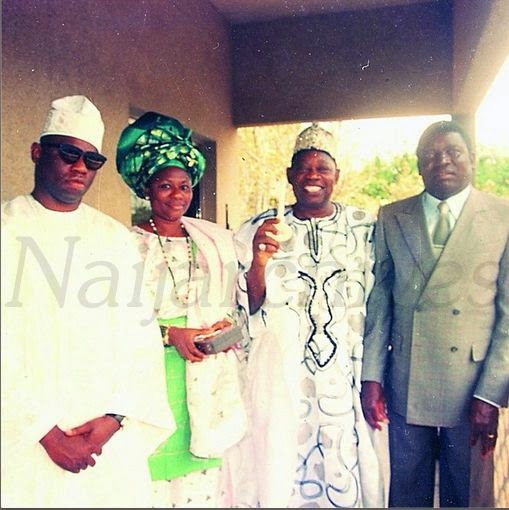
The late Chief Moshood Kashimawo Abiola and his late wife, Alhaja Simbiat Atinuke Abiola (née Shoaga), in the 1980s. Alhaja Simbiat was the CEO of Wonder Bakery, a distinctive Nigerian business that employed over 140 people when it first opened its doors in the early 1980s. Despite suffering from cancer, Alhaja Simbiat Abiola’s kindness was remarkable. She witnessed the devastation caused by the 1992 Cairo earthquake while lying on her sickbed and watching television. The Dahshur earthquake, which struck Cairo in 1992, is another name for it. She gave $100,000 from her hospital bed to support the reconstruction of a school for earthquake-affected children because she was so moved by the devastation in Egypt. Alhaja Simbiat Atinuke Abiola passed away in a British hospital in 1992 following a valiant battle with cancer. She was a very decent woman. May she always rest in peace with her soul.
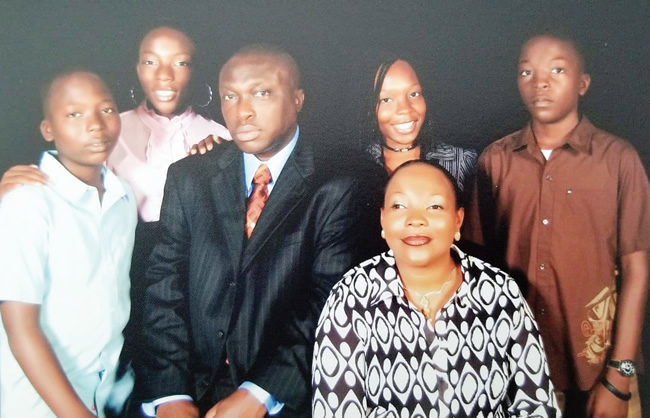
The family of Otunba Dipo Dino, also referred to as D D Direct, in the early 2000s, just prior to his assassination. He was a politician, community leader, administrator, philanthropist, and chartered accountant from Nigeria. According to Dina’s close friends, who thought the gunmen had killed him for money, when they blocked his car and opened the door, they revealed they had been paid to kill Dina. He was informed that someone had paid for his life and that it was his responsibility to cooperate and give up his life without resistance. Dina opened the door, maybe expecting to fight, but the men killed him with a single round of gunfire. Based on Witness report: “They really intended to remove his body, but he was already on the ground, and they realized they wouldn’t have enough time to carry it. They so stole his vehicle and the driver, leaving him behind in the Agbara region. Dipo entered the political scene in 2003 and, after leaving the now-defunct Action Congress (AC), ran for governor of Ogun State in the 2007 election. Approximately 400 students in the state were said to receive bursaries from him each year, and during his 2007 governorship campaign, the state’s elementary, secondary, and university schools received about four million free exercise books. He established the non-governmental organization “Ogunnet” to carry out his political initiatives. A few years later, former governor Ibikunle Amosun named the Otunba Dipo Dina International Stadium in Ijebu-Ode in his honor.
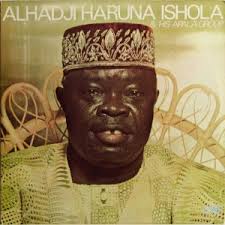
“Alowonle” was a significant player in the mid-20th century music scene. Born in the early 20th century in 1919, Haruna Ishola Bello MON passed away on July 23, 1983. Among the most well-known performers in the apala genre was him. Nigeria’s Ibadan is where he was born.is recognized as the founder of Apala music in Nigeria, using instruments including lamellophone, akuba, claves, drums, and agogo bells. In Nigerian courts, Haruna Ishola faced up against his former business partner in a historic case. Ishola wanted to establish his own record company in 1964 in order to take full creative control and management over his earnings. A respectable businessman was invited to join him as a partner. Renowned in the music world, Nurudeen Omotayo Alowonle was a shrewd investor. At the time, he was so well-known that any youngster with the name Nurudeen would go by his moniker, Alowonle. F. S. Balogun and another gentleman were also invited to join the company. Ishola recognized that the rules of engagement needed to be written down for the partnership to be legitimate, but he couldn’t afford a professional attorney because his previous label had mismanaged his revenues. The four agreed to become partners by signing a handwritten contract on May 28, 1964. “Express Record Dealers Association” was the moniker they settled on for the collaboration. The agreement states that the “Express Record Dealers Association” was established with the intention of releasing music under the distinctive label Alowonle Sounds Studio. The company chose Nurudeen Alowonle as its managing director. The company saw tremendous growth, but anxiety also accompanied the increased success. Alowonle was charged in 1966 with embezzling earnings and money from record labels into his own personal bank account. Dissolution of the partnership took place on February 7, 1967. The former partners then made the decision to retire the company name. In the middle of 1967, Ishola happened to come across several brand-new recordings at a nearby music store that were labeled “Express Record Dealers Association.” After purchasing many copies, he started a covert inquiry. He questioned who could have the guts to market the records under the former partnership’s trade name. It was the former Managing Director, Nurudeen Alowonle. Honorable Justice George Sodeinde Sowemimo presided over the case that Ishola dragged his former partner to. Alowonle filed for a trademark on the name in November 1967. However, when he presented the handwritten contract from 1964, Justice Sowemimo declared Alowonle’s trademark on the record label name void, forbade him from using the brand name independently, and ordered Alowonle to reimburse Ishola for money that was embezzled between 1966 and the partnership’s termination because he was unable to produce official documentation attesting to Ishola’s and the other two partners’ equitable share of profits.