Chief Hubert Ogunde and Adeyemi Afolayan, Two of Nigeria’s Greatest Theater Pioneers,

Chief Hubert Ogunde and Adeyemi Afolayan, popularly known as Ade Love, both grinning and radiating the warmth and  companionship that defined their relationship. This image is not just a snapshot in time; it is a powerful testament to the foundations  of Nigerian  theater and cinema, with these two legends serving as cornerstones in the industry’s development.  Chief Hubert Ogunde is  frequently referred to as the father of Nigerian theater. He pioneered the field by founding the Ogunde  Theatre Party, Nigeria’s first  professional theater company, in the  1940s.  His work set the stage for modern Nigerian theater by fusing traditional African  performance styles with modern themes to address  social, political, and cultural issues. Ogunde’s productions were renowned for  their potent storytelling, vibrant music, and dance. as well as their capacity to arouse curiosity and inspiration in viewers. In addition to being a musician and activist, he was also a playwright and director who used his craft to promote social change. Adeyemi Afolayan, better known as Ade Love, is a significant personality in Nigerian theater and film who stands next to him. Ade Love carried on Ogunde’s legacy, advancing the development of Nigerian theater and cinema. He was renowned for his  mesmerizing performances and his ability to bring Nigerian stories to life on cinema. He was not only an actor and director but also a producer of motion pictures. The popularization of Yoruba-language films, which are still an essential component of Nollywood, can  be attributed to Ade Love. His offspring, Kunle, Moji, Gabriel, and Aremu Afolayan, have all made noteworthy contributions to the Nigerian entertainment sector, mostly in the film and television industries, ensuring his legacy lives on. With their imagination and enthusiasm, these two trailblazers established the groundwork for a thriving business that still affects a  great number of performers, directors, and writers today.In addition to molding Nigerian culture, their achievements were crucial in  bringing African cinema to the attention of the world.    
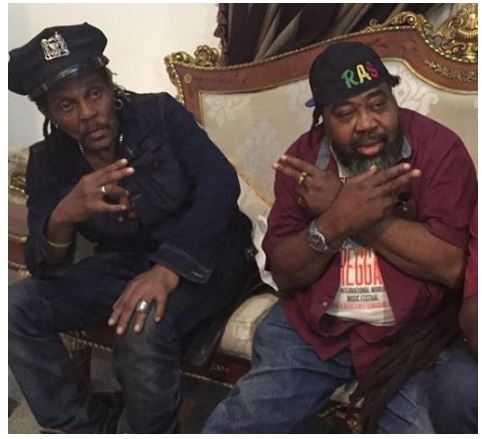
Amazing Friendship of Ras Kimono and Majek Fashek Before Their Demise

Majekodunmi Fasheke, popularly known as Majek Fashek, and Oseloke Augustine Onwubuya, better known as Ras Kimono. The two important figures in the history of African and Nigerian reggae are pictured together in this unusual photo, signifying an  important turning point in the genre’s development. Majek Fashek, also known as the “Rainmaker,” was acclaimed for his distinctive blend of reggae and traditional African rhythms,  while Ras Kimono was well-known for his socially aware lyrics and strong voice. This picture not only honors their relationship but also demonstrates their enduring influence on the world of music. Majek Fashek died in 2020, two years after Ras Kimono went away in 2018. May God grant them eternal rest. Their contributions to  music in general and reggae in particular will always be honored and appreciated.

Death of Chiboke De John, a.k.a CD John Via an Accident in Victoria Island, Lagos

As a rising figure in the Nigerian comedy scene, Chiboke De John, better known by his stage name CD John, made contributions to  reggae and music. On Thursday, March 24, 2011, a deadly auto accident ended his promising career. CD John, who was well-known  for his distinct approach to fusing comedy and music, attracted a devoted fan base very fast. Before the sad tragedy that took his life, he appeared to have a bright future in the entertainment world. Early in the morning, while CD John was returning from an album listening event for the musician Harrysong, the occurrence took place, held in Victoria Island’s Tribeca, located on Adetokunbo Ademola Street in Lagos. CD John performed as the event’s compere, showing his skills for a grateful audience.  Following the event, he got into a convoy of three cars, one of which was being driven by Kunle Oluwaremi, the winner of Gulder  Ultimate Search Season 7 and the character SARO in the movie Anikulapo, as they made their way to his residence in Jakande  Estate, Isolo, Lagos. Sadly, as its occupants were busy pasting campaign posters, the convoy came upon a stationary black Toyota Corolla, purportedly  one of Governor Babatunde Raji Fashola’s campaign vehicles, blocking the route. The convoy’s lead vehicle swerved and struck the Corolla’s rear side, but CD John’s fast-moving black Golf 3 struck the Explorer  Jeep, the second vehicle in the convoy, and broke apart. CD John was the only one in his car’s four occupants to die from his  injuries. The budding comedian was treated for severe head trauma at St. Nicholas Hospital in Lagos, but he was not able to recover. The Nigerian comedy scene was devastated by his sudden passing and the loss of a gifted comedian whose potential was never  completely reached. CD John’s untimely death serves as a reminder of both the transient nature of life and the importance of road safety.  

Throwback to “Knock Mi Off” by Plantashun Boiz Over Twenty-Four Years Ago

One of the hit songs by Plantashun Boiz, the legendary Afrobeat group consisting of Blackface, Faze, and 2Face Idibia (now known  as 2Baba), was “Knock Mi Off.” The late 1990s and early 2000s Nigerian music scene  was greatly influenced  by these three  musicians. Plantashun Boiz successfully captivated audiences with their distinctive sound, fusing Afrobeat with elements of R&B and reggae,  long before the social media era. They overcame the obstacles of the day to become well-known in Nigeria and beyond, greatly  advancing the country’s music sector. They cemented their status as some of the greatest musicians in African history by setting the path for a new generation of musicians.

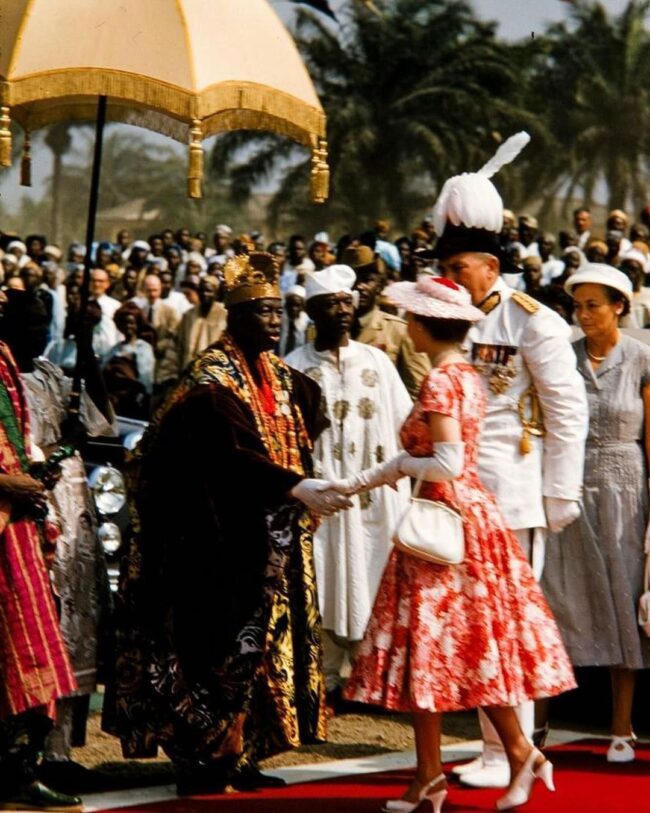
Oba Musendiku Buraimoh Adeniji Adele of Lagos greets Her Royal Majesty Queen Elizabeth II

During the queen’s official trip of Nigeria in February 1956, Oba Musendiku Buraimoh Adeniji Adele of Lagos welcomes Her Royal Majesty Queen Elizabeth II as Governor-General Sir James Robertson looks on. Oba Adele II was a member of Egbe  Omo  Oduduwa, which was led by Obafemi Awolowo, and she supported the Nigerian Youth Movement. As such, he was politically opposed to the ruling NCNC/NNDP, whose foundation was the House of Docemo, established by Herbert Macaulay and subsequently headed by Nnamdi Azikiwe. Since Oba Adele was not descended from Dosunmu, the NNDP  opposed  his ascent and brought legal actions to prevent his coronation. Finally, in 1957, the Judicial Committee of the Privy Council in England upheld Oba Adele’s title to the throne.

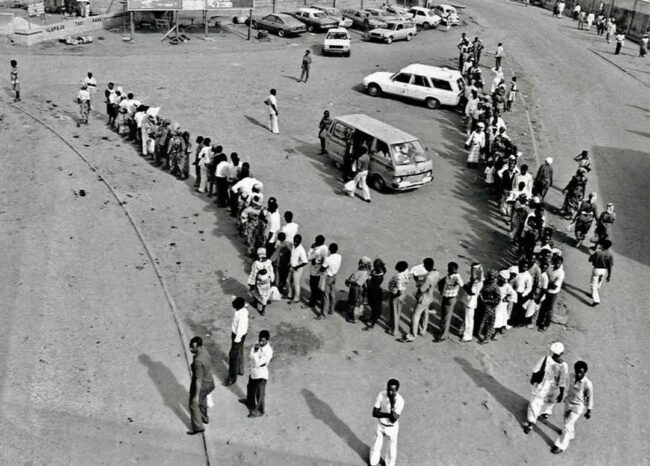
Nigerian Citizens Stranded in 1984 as a Result of War Against Indiscipline During Muhammadu Buhari’s Regime

A dramatic spectacle of stranded individuals standing in remarkably organized lines was captured on camera in 1984, and it signaled a momentous occasion in Nigerian history. The photo was shot under the military government of General Muhammadu Buhari, which instituted the “War Against Indiscipline”  (WAI) campaign, a strict program designed to bring back discipline, order, and patriotic values among Nigerians. March 1984 saw the implementation of the “War Against Indiscipline,” not long after Buhari was overthrown by a military coup. The program aimed to tackle the pervasive disorder, corruption, and social deterioration that had become entrenched in Nigeria. The implementation of public discipline, which included making line waiting at bus stops and other public areas mandatory, was one  of the main initiatives. Before this, Pushing and shoving were commonplace in Nigerian public spaces,  which were disorderly  and  chaotic. The image in question, which showed people queuing neatly at a bus stop—a rare sight at the time—became  representative of the WAI campaign. Many people were left stranded due to the shortage of buses caused by strict government rules and economic difficulties. Nonetheless, Buhari’s regime’s rigorous enforcement of discipline was evident in the well-organized lines. Admiration and anger  were mixed emotions throughout this time. Some praised the effort to foster a sense of order and patriotism, while others denounced  the approaches as harsh and autocratic. In addition, the program promoted national solidarity through a variety  of civic  responsibilities, enforced timeliness, and publicly  shamed individuals who littered. Therefore, the “No Buses” situation represented both the wider changes imposed by the military government as well as the economic struggles suffered by Nigerians. The “War Against Indiscipline’s” legacy is still up for discussion,  highlighting the  difficulties with  societal change and government throughout Nigeria’s history.

Enjoy This Comical Series by Gbenga Adeboye Titled “American Exposure” Part 2

Resurfacing brings back memories of the 1990s with a video that features one of the great works of the legendary comedian Gbenga Adeboye, commonly known as Abefe Funwontan, titled “American Exposure” Part 2. Gbenga Adeboye blends sarcasm,  cultural  insights, and his trademark comedic style to create a hilarious account of his adventures  in America in this debut edition  of the  comedy series “American Exposure.” This film serves as a nostalgic reminder of Gbenga Adeboye’s unmatched skill in the field of Nigerian humor for those who were born in the 1990s. Known for his versatility, Adeboye worked in the entertainment  industry as a comedian,  broadcaster, singer, and  cultural critic. His contributions have had a long-lasting effect. His standing as one of the greatest performers of all time was cemented by his ability to use humor to connect with a wide range of  audiences while tackling social issues. The legacy of Gbenga Adeboye, the “GOAT” of Nigerian comedy, is still  meaningful to  both  younger and older audiences. His singular fusion of insight, humor, and cultural criticism is still unrivaled. We pay tribute to his memory and the happiness he brought to many lives as we remember his contributions.

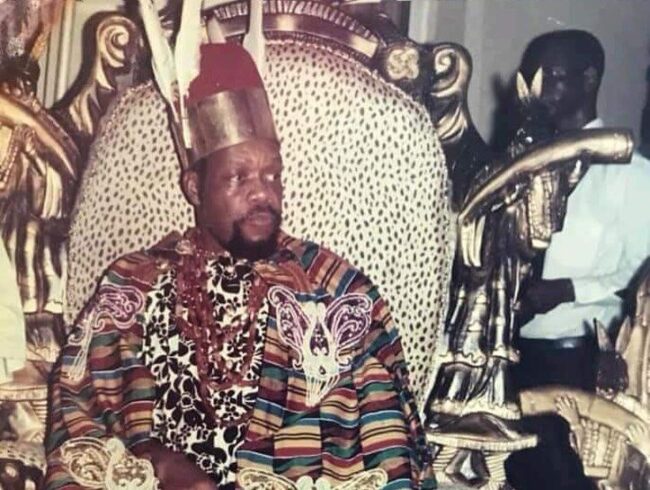
Pictures From Odumeje Ojukwu’s Coronation as Eze Ndi Igbo Worldwide

Two decades ago, on a grandiose day, the foremost traditional leaders of Igboland assembled to watch Dim Chukwuemeka  Odumegwu Ojukwu receive the title of “Ezeigbo Gburugburu” from the Adama Nri.   These emblems of monarchy, authority, and power were conferred onto Igboland by these ancient guardians of the original Ofo Nri-Menri and Alo Nri-Menri, which are situated in Nri—the traditional homeland of the Ndigbo people.

A Typical Monday Morning in Lagos in 1971, Share Your Thoughts in the Comment

A film shot in 1971, a year after the Nigerian Civil War ended, shows a typical Monday morning street scene in Lagos, providing a  unique window into the everyday lives of those who live there. The video shows individuals rushing to get to work, capturing the vitality and tenacity of a city that has been thriving for more than a century. Lagos, the center of Nigerian culture and commerce, has long been known for its fast-paced atmosphere  and distinctive  rhythmic streets.  The video emphasizes how Lagosians had to maintain their vigilance and alertness even in the early 1970s, particularly when  boarding the commercial buses. Being agile is essential; this is a Lagos tradition that has lasted for many years. This scene from 1971 brings back a lot of memories, especially for anyone who are aware of the city’s timeless quality. In addition to demonstrating the consistency with which Lagosians manage their daily journeys, the video serves as a timely reminder of the city’s pivotal role as a vibrant hub of opportunity and survival. By using this historical perspective, we can see how Lagos’ fundamental characteristics haven’t altered over time—its streets continue to bustle with the same tenacity, energy, and hustle that have characterized the city for more than a century.